
Miss World Australia Takes a Piece of the Australian Coastline to the World Stage.
Three South Australian women have transformed one of Australia’s most extraordinary natural landscapes into wearable art, with Miss World Australia Olivija Spanovskis set to unveil the Ningaloo Gown at the 73rd Miss World Festival.
Where the rust-red Australian outback meets the brilliant blue of the Indian Ocean, one of the country’s most remarkable landscapes has become the inspiration for Australia’s latest statement on the world stage.
Miss World Australia Olivija Spanovskis will represent the country in the Designer Award at the 73rd Miss World Festival wearing the Ningaloo Gown, an intricate couture creation inspired by Western Australia’s Ningaloo Reef and Cape Range.
But behind the gown is another distinctly Australian story.
Created entirely in Adelaide, the piece brings together three South Australian women: Spanovskis, couture designer Tasmin Jade, and fine artist Mary Zammit. The collaboration transforms Olivija’s personal connection to Ningaloo into wearable art, carrying a landscape from the opposite side of the country onto an international stage.

Photography credit: Jordan Lavis | @jordanlavis_photography
A landscape Olivija wanted the world to see...
For Spanovskis, Ningaloo was never chosen simply because it would make a beautiful gown.
Growing up travelling through regional and remote Australia fostered an early appreciation for the country’s natural environment, but her experiences at Ningaloo deepened that connection.
Swimming alongside whale sharks, watching turtles move through crystal-clear waters, exploring the ancient Cape Range and learning from the stories and perspectives of First Nations peoples left Spanovskis with a belief that experiencing a place can fundamentally change the way people value and protect it.
That philosophy now sits at the heart of her environmental advocacy and Our Kanyini, alongside her work promoting more conscious, purpose-led travel.
“Some places stay with you long after you’ve left them. For me, that place is Ningaloo Reef on Western Australia’s Coral Coast,” Spanovskis said.
“Experiencing Ningaloo reinforced my belief that meaningful connections with places inspire conservation.”
It is a connection reflected in the official design concept, which describes Spanovskis’ firsthand experience through eco-tourism as shaping her appreciation for the relationship between travel, conservation and stewardship of Australia’s natural environments.
When the opportunity came to create a gown for Miss World, the objective became bigger than producing something spectacular.
Spanovskis wanted to wear a place that mattered to her.

From ochre earth to Indian Ocean
Months of design and craftsmanship followed.
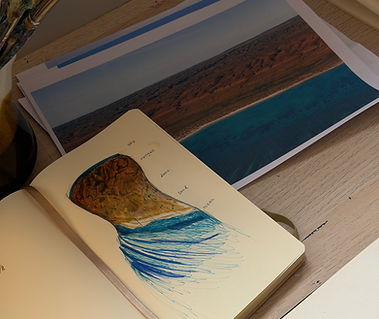
Rather than interpreting Ningaloo through ocean colours alone, Tasmin Jade approached the gown as an entire landscape, translating its structure, movement and geography into couture.
From above, Ningaloo presents an extraordinary natural collision: the ochre earth and ancient ranges of Cape Range National Park move through sweeping dunes before meeting turquoise reef and the deep blue Indian Ocean.
That transition from land to sea became the architecture of the gown.
At its centre is a sculpted corset with a softly scalloped hemline echoing the curves of the Ningaloo coastline from an aerial perspective. Instead of treating the bodice as a conventional piece of couture, it became a literal canvas.
Zammit hand-painted an original interpretation of Cape Range and its surrounding dunes directly across the corset, allowing the landscape to curve around the body and change as Spanovskis moves.
From there, the earth appears to dissolve into ocean.
A fit-and-flare mermaid skirt constructed from layers of liquid organza moves through rich teal and deep ocean blue. Beneath it sits a luminous base chosen to recreate sunlight dancing across the surface of the water.
Godets through the skirt and train create volume and fluidity, while cascading chiffon evokes the rhythm of the sea. Hand-applied beadwork follows elements of the landscape and individually positioned clear crystals catch the light, recreating the glimmer of sea spray.
The result is not simply a blue gown inspired by a reef. It is designed as a visual journey from earth, to coastline, to ocean.
The Design Process, Australia's submission for the 73rd Miss World Designer Award.
Couture becomes canvas
The project also marks an unusual meeting of two creative disciplines.
Adelaide artist Mary Zammit is a self-taught representational artist who works predominantly in oils, with Australia's coastlines and landscapes forming a recurring influence throughout her career. Her relationship with the Australian environment began during a childhood spent travelling around the country, where she would sketch the landscapes and people she encountered.
For the Ningaloo Gown, however, she had to trade a conventional canvas for a three-dimensional corset.
Painting across a structured garment meant the artwork had to respond not only to light, colour and composition, but to the architecture and movement of the human body.
“My work has always been inspired by Australia’s coastlines and landscapes, so it felt really natural to create this piece inspired by the Ningaloo region,” Zammit said.
“I wanted to capture its colours and movement in a way that worked with the structure of the corset. It’s been a privilege to paint this for the Miss World Australia gown.”
The collaboration effectively blurs the boundary between the gallery and the runway: Tasmin’s couture becomes Mary’s canvas, while Mary’s landscape becomes part of Tasmin’s silhouette.
A South Australian fashion story
While the gown tells the story of Western Australia, its makers are proudly South Australian.
Tasmin Jade specialises in one-of-a-kind, made-to-measure couture from Adelaide, with a philosophy centred on creating what she describes as modern heirlooms: garments intended to hold enough craftsmanship, individuality and meaning to be kept and eventually passed on.
Her connection to dressmaking stretches back generations. Tasmin’s great-grandmother was a dressmaker who created custom garments by hand, becoming one of the designer’s earliest creative influences. Today, every Tasmin Jade piece is individually conceived and constructed, with no two garments the same.

Mary Zammit | @maryzammitart | www.maryzammit.com

Tasmin Jade | @tasminjadecouture | www.tasminjade.com.au
For the Ningaloo project, that philosophy meant resisting the temptation to simply reference the reef through colour.
“When I started designing the Ningaloo Gown, I wanted to capture more than just the colours of the ocean. I wanted to tell the story of the coastline itself,” Tasmin said.
“Every fabric, colour and detail was chosen to represent the movement of the water, from sunlight reflecting on the surface to sea spray rising from crashing waves.”
For Tasmin, Ningaloo represents the rare harmony between two dramatically different Australian environments.
“Western Australia is home to some of the most spectacular coastal scenery in the world, and Ningaloo is a place where land and ocean exist in extraordinary harmony. Through this design, I hope to showcase that natural beauty and share a piece of Australia’s landscape with the world.”
Photography credit: Jordan Lavis | @jordanlavis_photography


More than a gown
For Spanovskis, the finished creation represents several stories at once.
It is a celebration of Ningaloo and the memories she holds there. It is a platform for conservation and responsible travel. It is also an opportunity to showcase Australian female creativity internationally.
“This gown is an ode to Ningaloo Reef, the memories it holds and the landscapes that continue to shape Australia’s natural identity,” Spanovskis said.
“It is also a celebration of the remarkable talent of South Australian creatives, whose artistry has brought this vision to life, allowing me to share Australia’s story and champion the conservation of the extraordinary places that define our nation for generations to come on the Miss World stage.”
And perhaps that is what makes the Ningaloo Gown particularly Australian.
Its story begins thousands of kilometres from the atelier where it was made. Ochre ranges become a hand-painted corset. Dunes become contours. Sunlight becomes fabric. Sea spray becomes crystal.
Three South Australian women have taken one of the country's great natural landscapes and translated it into something that can walk.
As Australia's Designer Award submission puts it:
It is not simply a gown inspired by Australia. It is a piece of Australia, created by Australian women, to be carried onto the world stage.